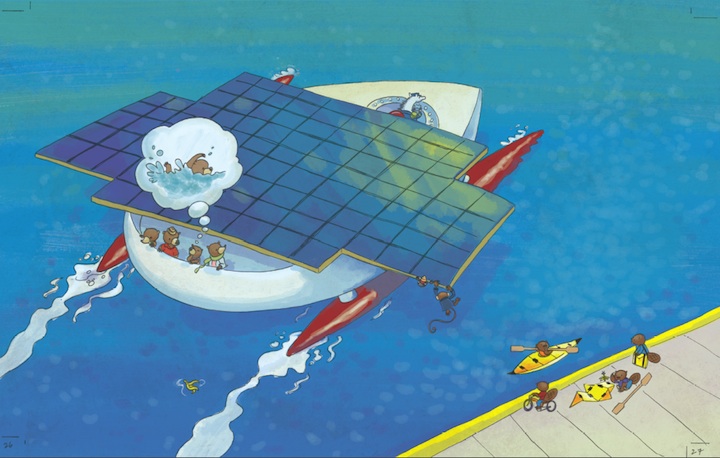
We have more sneak peeks from our book, Bicycles, Airships and Things that Go. Illustrator John Aardema had been hard at work and we’re starting to see these great results for our story.
[metaslider id=663]
Learn more about this title here. Would you like to be one of our test readers? Contact Ann at AB (at) kidsfuturepress (dot) com by September 30th, 2014.
A good play on words here. The Science Runway, like the fashion runway, deals in models. Only The Science Runway is about role models that will inspire girls to join fields in healthcare and life sciences.
Founder Akhila Satish says “We believe that every little girl can grow up to be their own version of a brilliant, beautiful woman in science like each of our role models are! There is no single path of science for women.”
An Australian after-school program has set out to teach kids the value of money by putting them into a hands-on “mini economy” reports news.com.au. At Kids at Switch, children (aged 5 to 12) choose jobs and do work, such as app developers, authors, small business owners or website coders.
kids own the shop and buy and sell goods
Their work in the simulated learning economy earns “money” to pay rent and bills. For example at the program they must either rent a chair to sit on or save up to buy one. They can even buy a second chair to rent to classmates. Kids also run a shop during each session.
The program helps kids develop financial literacy. For example, students divide their money into categories for investing, spending (according to a budget), saving, and sharing (donating). Their online accounts are accessible during the program and from home.
What would be interesting from a sustainability perspective is teaching kids about how our “money” economy currently doesn’t account for damage to natural resources—like the air we breathe or the ground water we drink. How would these lessons look in a “green economy” complete with collaborative consumption (the sharing economy) and carbon pricing? !
This story reminds us of how one school district used the building of a new school to involve kids in hands-on STEM learning form professionals working on the school, ranging from plumbers to architects. Read the post here.
A few months back I wrote a post about 6 ways that bicycles help kids learn about sustainability. Innovation was one — and there were some crazy and wonderful pictures.
So when I saw this 3D printed mesh bicycle frame I just had to add it to the “catalogue” of bicycle innovations that are sure to get kids thinking about how we make (engineer) things. The green wheels are a nice touch too!
This bike was created by Australian industrial designer James Novak and I learned about it on i.materialise, where Novak said,
“What I really wanted to achieve was something that takes full advantage of the benefits of 3D printers, especially the ability to create one-off, customizable pieces that may be lighter-weight and stronger than traditional frames through the use of complex lattice structures. More than anything, I’d like my work to be an example of what we should be 3D Printing.”
From a sustainability angle, lighter weight makes bicycling more accessible and I can see this mesh design having implications for folding or other “portable bikes” that you might take on the train and such.
So what do you think? Would you ride it? How about the kids you know?